Shipping musical instruments: a comprehensive guide to each instrument, packaging and costs
You’ve sold your guitar on Subito.it and now you need to post it to Sicily. Or perhaps you’re a musician sending your amplifier ahead of a tour. Or maybe you simply need to send a violin as a present to your nephew who lives 800 km away. Whatever the reason, sending a musical instrument requires a bit more care than a normal parcel — and getting it wrong could mean ending up with a guitar neck in three pieces.
In this guide, you’ll find specific instructions for each type of instrument, estimated costs, a comparison of couriers, and everything you need to ensure your instrument arrives safely at its destination.
Table of Contents
General guidelines before sending any instrument
Whether it’s a €200 trumpet or a €5,000 violin, there are certain things that always hold true, regardless of the instrument.
🌡️ Temperature and humidity: wood’s invisible enemy
Almost all high-quality musical instruments are made of wood, and wood expands and contracts with changes in temperature and humidity. A parcel moving from a heated van to a cold warehouse can cause the joints of an acoustic guitar to give way, the soundpost of a violin to come loose, or the soundboard of a mandolin to split. This is not the courier’s fault: it is the chemistry of the wood.
✅ When posting wooden instruments, pop a small sachet of silica gel inside the case to absorb any fluctuations in humidity during transit. It costs less than €1 and can save an instrument worth thousands of euros.
📷 Always take photos before posting
- Take photos of the instrument from several angles before packing it away — front, back, neck, body, and any signs of wear and tear
- Take a photograph of the inside of the case with the instrument in place
- Take a photo of each layer of the packaging as you put it together
- Keep these photos: they are your only evidence in the event of a complaint
⚠️ Without photos taken before dispatch, any claim for damage becomes extremely difficult to substantiate. The courier may dispute that the damage was already present before dispatch.
🎸 Hard case vs soft case: does it make a difference?
A great deal. A hard case (made of fibre, ABS or wood) is designed to absorb direct impacts and distribute pressure. A soft case (the classic neoprene gig bag) protects against scratches but not against impacts. If you’re posting a valuable instrument, a hard case isn’t just an option: it’s the foundation of the protection system. The outer box acts as a second layer of protection, not the first.💡 If you’re not sure how to pack your instrument properly, read our guide on the most common packing mistakes to avoid first.
🎸 How to post a guitar (acoustic or electric)
The guitar is the most commonly sold musical instrument in Italy — thanks to eBay, Subito.it and the huge community of musicians who buy and sell second-hand instruments online. Electric guitars are generally more robust and compact; acoustic guitars have a body that is more vulnerable to side impacts.
Before packing: preparatory steps
- Loosen the strings to the minimum tension — the difference in pressure during transport (especially by plane) can put pressure on the neck if the strings are too tight
- Remove the strap, picks and any attached accessories
- Protect the mechanical parts (the tuning pegs) with a sponge or bubble wrap — they are fragile protruding parts
- Place a cushion of bubble wrap or soft foam between the strings and the keyboard to prevent them from vibrating during transport
Packaging: step by step
- Place the guitar in its hard case with the clasps fastened — if you don’t have a hard case, wrap the entire body and neck in a primary layer of bubble wrap (at least 3 layers)
- Choose a double-walled cardboard box that is slightly larger than the case — for standard guitars, a box measuring 130×50×20 cm will suit most models
- Place 5 cm of padding at the bottom of the box (bubble wrap or polystyrene chips)
- Place the guitar in its case and fill in the gaps at the sides — the guitar mustn’t move a millimetre
- Place 5 cm of padding on top before closing the box
- Seal with H-shaped tape at the top and bottom, and attach a ‘FRAGILE’ label to all sides
- Please place a copy of the label showing the sender and recipient inside
| Type | Typical weight (including packaging) | Box dimensions | Estimated volumetric weight |
|---|---|---|---|
| Standard electric guitar | 3–5 kg | 110×40×15 cm | 13 kg |
| Dreadnought acoustic guitar | 4–6 kg | 130 × 50 × 20 cm | 26 kg |
| Classical guitar | 3–5 kg | 120×45×18 cm | 19 kg |
| Semi-acoustic guitar (jazz) | 4–6 kg | 130 × 45 × 20 cm | 23 kg |
| Electric bass guitar | 4–6 kg | 125 × 45 × 18 cm | 21 kg |
The volumetric weight is calculated using the formula: L × A × H (cm) ÷ 5000. The courier charges based on whichever is greater: the actual weight or the volumetric weight.
🎻 How to post a violin, viola or cello
Stringed instruments are among the most delicate and often the most valuable. A master-crafted violin can be worth tens of thousands of euros, and damage caused by impact or temperature changes may be invisible from the outside but devastating to its resonance. For instruments worth more than €1,000, you should seriously consider having them transported by a professional escort rather than sending them by post.- Loosen the headband — the horsehair must be completely slack during transport
- Do not leave the sponge or humidifier inside the violin during dispatch — it may shift
- Wrap the headband separately in bubble wrap and place it in its slot in the case
- For violins: only use certified hard cases for transport — soft cases do not protect against knocks
- For cellos: a hard case is compulsory; consider a second padded outer box
⚠️ For antique instruments or those of exceptional craftsmanship, standard courier delivery is not recommended. An 18th-century instrument may require an export licence from the Ministry of Culture before crossing borders. Read the Ministry of Culture’s guidelines: https://www.beniculturali.it/esportazione
🎹 How to post a musical keyboard
A musical keyboard is one of the most difficult instruments to post, not because of its inherent fragility, but because of its size. An 88-key keyboard can be over 120 cm long and weigh more than 15 kg — and it has keys that protrude and can break if the box is subjected to side impacts.- Protect the keys by placing a sheet of stiff cardboard across the entire keyboard and securing it with tape — the white keys may break if pressed directly
- Wrap the keyboard in bubble wrap all the way round (at least 3 layers), taking care with the knobs and the connectors on the sides
- Use a triple-wall cardboard box for keyboards weighing more than 10 kg
- The stands must be dismantled and sent separately, or wrapped separately within the same box
- If the keyboard is in its original packaging: always use it — it is moulded to fit the instrument exactly
💡 For 88-key keyboards weighing more than 20 kg, the volumetric weight can be a significant factor. Always measure the length, width and height before requesting a quote.
Typical weight and dimensions — keyboards
| Type | Typical weight | Typical dimensions | Notes |
|---|---|---|---|
| 61-key stage piano keyboard | 8–12 kg | 110 × 40 × 20 cm | Volumetric weight ~18 kg |
| 76-key keyboard | 12–16 kg | 130 × 45 × 20 cm | Volumetric weight ~23 kg |
| 88-key keyboard (standard) | 15 0 25 kg | 145 × 50 × 25 cm | Volumetric weight ~36 kg |
| 88-key digital piano (weighted keys) | 25–40 kg | 150 × 55 × 30 cm | ~50 kg (volumetric) — we recommend shipping on a pallet |
🥁 How to post an acoustic drum kit (and how much it costs)
Shipping a drum kit is something that needs to be planned in advance. It isn’t a single parcel: a standard drum kit consists of 5–8 separate items (bass drum, snare drum, toms, floor tom, cymbals, hardware) which each require their own packaging. The challenge isn’t technical — it’s logistical.
How to arrange the dispatch of a battery
- Package 1 — Box: The large snare drum requires a made-to-measure box or the original box. Remove the heads and send them in the same box, wrapped separately. Typical weight: 8–15 kg; box dimensions: 65×65×65 cm.
- Pack 2 — Tom and floor tom: They can be packed into a box if the dimensions allow. Always remove the supports. Wrap each drum separately in bubble wrap. Typical weight: 6–10 kg.
- Pack 3 — Hardware (stands, pedal, hi-hat): Heavy but relatively sturdy components. Wrap fragile parts (snare rims, ring nuts) in bubble wrap. Typical weight: 8–15 kg.
- Package 4 — Dishes (if included): The plates are fragile and heavy. Each plate must be wrapped individually in thick bubble wrap, then placed upright in a padded box. Do not stack them without protection.
- Pack 5 — Snare drum: Treat it as if it were a small drum — wrap it in bubble wrap and place it in a suitably sized padded box.
⚠️ The maximum weight limit per parcel for express couriers is 60 kg. A large battery case containing hardware may come close to this limit if the load is not distributed correctly. Weigh each component before packing to avoid any surprises at the time of collection.
How much does it cost to post an acoustic battery?
The cost depends on the number of parcels and the volumetric weight of each one. A standard 4-pack battery, with delivery anywhere in Italy, costs approximately between €60 and €120 in total, depending on the courier and the dimensions. Use our calculator for an accurate quote for each parcel separately.
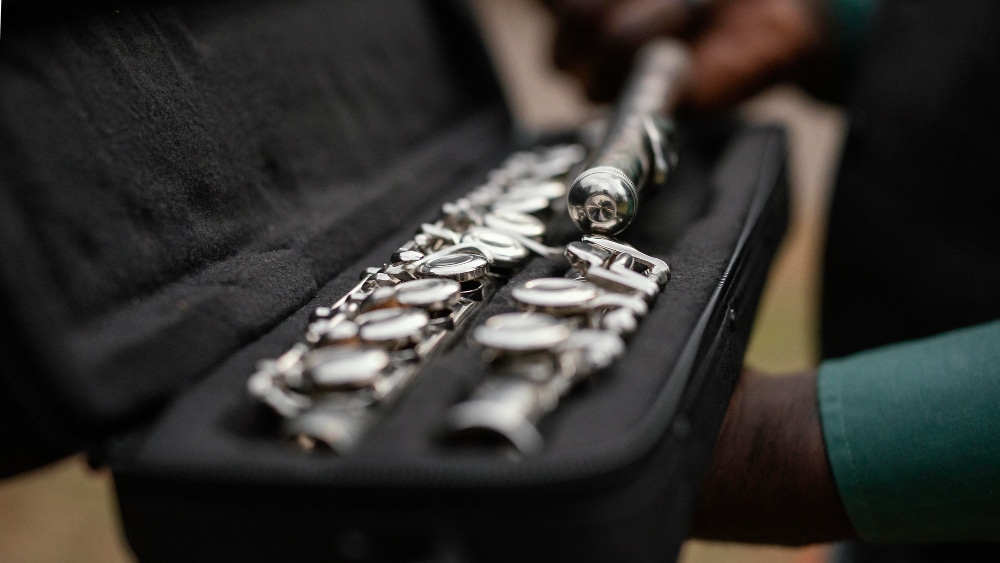
🎺 How to post wind instruments (trumpet, saxophone, flute, clarinet)
Wind instruments have valves, keys and delicate mechanisms that can be bent out of shape by even the slightest pressure. The problem is almost never the sturdiness of the instrument itself, but that of the case and the box.
- Always use the instrument’s original hard case — it is designed to keep each part in its exact place
- Remove the mouthpiece and post it separately in the same box, wrapped individually
- For brass instruments (trumpet, trombone, French horn): empty out all the water completely before packing them away
- For the saxophone: remove the mouthpiece and the mouthpiece cap, and pack them separately inside the case
- Wrap the case in bubble wrap and place it in a cardboard box with 5 cm of padding on all sides
- For flute and clarinet: small instruments with extremely delicate mechanisms — use rigid foam moulded around the keys, not just ordinary bubble wrap
🎹 Shipping an upright or grand piano
An upright piano weighs between 200 and 400 kg. A grand piano weighs even more. These instruments cannot be sent via a standard express courier service: they require a specialist removal firm equipped with trolleys, professional straps and, in many cases, partial dismantling.
If you need to move a piano within Italy or abroad, please contact us directly for a bespoke quote: we organise specialised transport with operators who specialise in large musical instruments.
→ Please contact us for a quote on pianos and oversized instruments
💶 How much does it cost to post musical instruments: a guide to prices
Prices depend on actual weight, volumetric weight and destination. The prices below are indicative for standard shipments with home collection in Italy (not express).
| Instrument | Typical weight (including packaging) | Italy (country code) | Europe (indicative) |
|---|---|---|---|
| Electric guitar | 3–5 kg | from €15–20 | from €25–40 |
| Acoustic guitar | 4–6 kg | from €20–30 | from €35–55 |
| Electric bass guitar | 4–6 kg | from €18–28 | from €30–50 |
| Violin (with hard case) | 2–4 kg | from €12–18 | from €22–35 |
| Cello (with hard case) | 8–14 kg | from €25–40 | from €45–70 |
| 61-key keyboard | 10–14 kg | from €22–35 | from €40–65 |
| 88-key keyboard | 20–30 kg | from €40–65 | from €75–120 |
| Trumpet / Saxophone | 3–6 kg | from €14–22 | from €25–45 |
| Acoustic drum kit (4–5 sets) | 40–70 kg | from €60–120 | from €120–200 |
| Guitar amplifier (combo) | 20–40 kg | from €30–55 | from €55–90 |
Prices are indicative and exclude the variable fuel surcharge. Use the online calculator for an up-to-date quote.
🚚 Which courier should you choose for musical instruments: DHL, UPS or FedEx?
At SpedizioneComoda, we work with DHL, UPS and FedEx/TNT — the three major international express couriers. For musical instruments, the choice depends on the instrument, its volumetric weight and the destination.
DHL Express — the most extensive air network
DHL Express It is the first choice for valuable instruments and international shipments. The direct air network reduces the number of sorting stages — fewer hubs mean fewer opportunities for damage. Whether it’s a €2,000 violin heading to Berlin or a guitar bound for New York, DHL Express minimises both the physical risk and delivery times.
- Strengths: real-time tracking, extensive international network, speed (1–2 days in Europe), consolidated customs clearance
- Ideal for: valuable instruments, international shipments, delicate violins and brass instruments
UPS — reliable for heavy parcels and European routes
UPS often offers competitive rates for heavy and bulky instruments to major European destinations. Its collection and delivery network is extensive and reliable for keyboards, amplifiers and drums on both domestic and continental routes.
- Strengths: Competitive rates for high actual weights, excellent EU coverage, reliable domestic service
- Ideal for: keyboards, amplifiers, drum kits – multi-colli consignments to Europe
FedEx / TNT — strong on the Italy–US route
FedEx excels on the Italy–US route and for shipments outside the EU in general. For a musician who needs to send their guitar to the United States, FedEx often offers the fastest delivery times and the most reliable US customs clearance service.
- Strengths: Record transit times for the US and Asia, streamlined US customs procedures, integration with TNT for Europe
- Ideal for: shipments outside the EU (USA, Canada, Australia), musicians on overseas tours
💡 With SpedizioneComoda, you can compare DHL, UPS and FedEx rates in real time for your specific item. Enter the exact weight and dimensions into the calculator — including the volumetric weight — and choose the best balance of price, reliability and speed.
🛡️ Insurance for musical instruments: when it is essential
The basic cover included in standard shipments is between €50 and €100 per parcel — an amount that is insufficient for any high-quality musical instrument. Additional insurance based on the declared value is practically essential for any instrument worth more than €200.
- Instruments under €200: Basic coverage may be sufficient for low-quality entry-level instruments
- Instruments costing between €200 and €1,000: Always take out insurance for the declared value — the additional cost is minimal (usually 1–3% of the value)
- Instruments costing over €1,000: compulsory insurance: always take a photograph of the instrument and keep documentation of its value (original invoice or valuation report)
- Antique or collector’s instruments: Consider taking out a specialist insurance policy for works of art — standard couriers’ policies may contain exclusions
⚠️ Always declare the instrument’s actual value. Under-declaring it to save on the insurance premium means that, in the event of damage, you will receive a payout proportional to the declared value, not the instrument’s actual value.
🌍 Sending musical instruments abroad
No additional customs documents are required for shipments within the European Union. For shipments outside the EU (UK, USA, Australia, Switzerland, etc.), a pro forma invoice stating the description and declared value is always required.
- USA: For instruments valued at over $800, a formal declaration to CBP (US Customs) may be required. For vintage or antique instruments, check for any CITES restrictions on exotic woods (rosewood, ebony — found on many classical and acoustic guitars).
- The UK after Brexit: Treated as a non-EU country from 2021. A pro forma invoice and customs declaration are required. Allow an extra 1–2 days for HMRC customs clearance.
- Switzerland, Norway: Outside the EU but well integrated logistically. Customs clearance times are generally quick.
⚖️ For antique instruments or those of historical value, Italian law (Legislative Decree 42/2004) may require an export licence for objects of cultural interest. The official guidelines are available on the Ministry of Culture’s website — in the ‘Exports’ section.
→ Read the complete guide to international shipments from Italy.
❓ FAQs — SENDING MUSICAL INSTRUMENTS
Do I need to loosen the strings before posting a guitar?
Yes, always. Changes in pressure during air travel and fluctuations in temperature can increase the tension on the neck. Loosening the strings reduces this stress and prevents warping, particularly on the slender necks of acoustic guitars. There’s no need to remove them: simply loosen them to the minimum tension.
Can I post a guitar without a case?
Technically, yes, but it’s not advisable for valuable instruments. Without a hard case, the entire protection system relies solely on the layers of bubble wrap and the box. For a guitar costing under €100 (a toy or entry-level practice guitar), this may be acceptable. For anything else, invest in a hard case — it costs less than the risk.
How much does it cost to post a guitar to Italy?
A standard electric guitar (packaged weight ~4 kg, volumetric weight ~13 kg) costs approximately between €15 and €25 using the services available on SpedizioneComoda.com. An acoustic guitar (larger body, volumetric weight ~26 kg) costs between €20 and €35. Use the online calculator for an up-to-date quote.
How can I send a musical keyboard safely?
Protect the keys with a sheet of stiff cardboard along their entire length, wrap them in bubble wrap, and use a triple-walled box for instruments weighing over 10 kg. If you have the original box, always use it: it is made to the exact dimensions. Always remove the stands and send them separately or wrap them up on their own.
Can I send a drum kit via a standard express courier?
Yes, but as a multi-parcel shipment. The drum kit must be dismantled and sent in 4–5 separate parcels (bass drum, toms, hardware, cymbals, snare drum). Each parcel is weighed and priced individually. The total cost for a standard drum kit in Italy is typically between €60 and €120.
Which couriers are best for sending musical instruments?
It depends on the instrument and the destination. DHL Express is the best choice for valuable instruments and international shipments — its air network minimises the number of sorting stages. UPS is competitive for heavy keyboards and amplifiers on European routes. FedEx excels on the Italy–US route. With SpedizioneComoda, you can compare all three in real time to find the best price for your specific instrument.
Do you need special insurance for antique or handmade musical instruments?
For instruments of historical value or fine craftsmanship (worth over €1,000), the courier’s standard insurance may not adequately cover the actual value. Consider taking out a specialist insurance policy for musical instruments. For instruments over 50 years old and of cultural significance, some countries require prior authorisation for export.
What should you do if the instrument arrives damaged?
Take a photo of the outer packaging straight away before opening it, then take a photo of the contents. Do not throw the packaging away. Contact the courier or our team within 24–48 hours. Read the full guide at What to do in the event of a non-delivery or damage.