Free export declaration for extra-EU shipments
The free export declaration is one of the essential documents for making a international shipping from Italy to a country outside the European Union (some still use the term “extra CEE”). In fact, if you are preparing a parcel to be sent outside the EU, you will have to fill in this document.
After the effective exit of the United Kingdom from the European Union, the shipments to London and throughout England will need this document. So, let's see the details of how to send a parcel and how the free export declaration works.

Index
What is the free export declaration for?
It is a document intended for customs authorities of the country of departure and destination of the shipment. In this case, therefore, it will not only be Italian customs, but also foreign customs.
When shipping from Italy to a non-EU country a parcel has to pass through two separate customs. The first is that of the sender's country, in this case Italy. The second is that of the destination country, such as Australia or Canada.
This document therefore fulfils the following fundamental functions:
- ensures that the goods included in the shipment are not subject to export restrictions under applicable European regulations. Accordingly, the sender hereby declares that he is aware of these laws;
- certifies that the shipment does not include any prohibited items. You can find a detailed list of prohibited articles, whose international shipment is prohibited.
- raises the express courier from any liability relating to the contents of the shipment. Therefore, it also has the function of protecting the courier company that delivers your shipment;
- allows the Italian customs authorities and those of the country of destination to clear your package through customs. In fact, without this document, the Italian customs will not be able to let the shipment proceed to its final destination. Likewise, the destination customs will not be able to let the parcel proceed to the consignee.
Download the free export declaration
Through these links you can download the facsimile of the free export document to be filled in, on which you can enter your shipment data:
- declaration of free export in English - facsimile document in Word format (.docx)
- free export declaration in English - facsimile document (PDF format)
Information included on the free export declaration
The information to be included on the declaration of free export falls into two categories, which we will elaborate on below:
- personal data of the sender;
- the country of origin of the goods shipped;
- the country of destination of the shipment;
- information regarding the European regulation governing the export of certain articles.
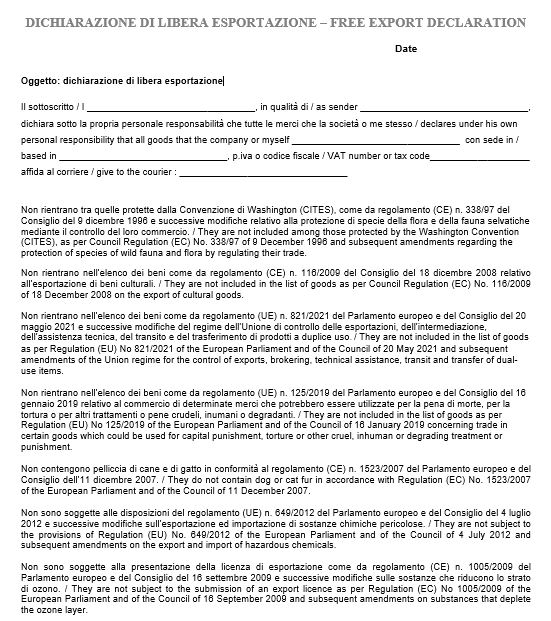
While it will be your responsibility to include your personal data on the document, the articles of the applicable European regulations will already be present on the blank template. This is what a completed free export declaration looks like:
Personal data to be reported on the declaration
The free export declaration must necessarily include the sender's data. The free export declaration form to be completed is the same whether the sender is a private individual or a company. However, you should check the information below and attach the correct data.
The following personal information must be present on the declaration:
- sender's first and last name;
- sender's role in the company (only in the case of shipment by a company);
- date and place of birth of the sender;
- sender's place of residence;
- shipment reference number, as stated on the consignment note;
- invoice reference number proforma or commercial invoice;
- VAT number or tax code of the sender, depending on whether it is a company or a private individual.
Information on the European Export Regulation
The sender declares that he is aware of the laws on the export of goods outside the EU. Specifically, by completing this declaration, the sender declares that he is not shipping:
- protected species of flora and fauna, according to the Washington Convention;
- items on the list of protected cultural heritage, according to the European Council;
- dual-use items (dual use) civil and military, the transfer of which is regulated by the European Union;;
- goods that could be used to facilitate capital punishment, torture or other cruel, inhuman or degrading treatment or punishment;
- articles containing dog or cat fur;
- hazardous chemicals whose import or export is prohibited by European regulations;
- goods whose export refund rate exceeds 10,000€;
- articles and equipment containing fluorinated gases greenhouse effect;
- goods that promote the illegal fishing unreported and regulated.
- articles containing substances that deplete the atmospheric ozone layer;
- goods intended for supporting military activities in Côte d'Ivoire;
- assets relevant to the current restrictions of the European Union towards Zimbabwe, of the’Iran, of Libya, of Republic of Guinea, of Myanmar, and the North Korea;
- articles relevant to the current restrictions on Russia's actions in Ukraine;
- goods included in the current restrictions on situation in Crimea;
- articles included in the current restrictive measures against certain Belarusian officials;
- goods relevant to the current restrictions on the situation in Syria.
How to fill in the declaration?
Filling out the free export declaration is simple. In fact, you only need to include the information in the previous paragraph on the form to be able to dispatch parcels correctly. However, watch out for 3 tricks that will enable you to prepare this document quickly and without errors.
- The declaration must be typed (handwritten declarations will not be accepted) e report date and signature of the sender .
- If it is a company making an extra-EU shipment from Italy, it must stamp and sign the declaration of free export, preferably on letterhead;
- The document must be ready at the time of the order, i.e. it must be uploaded electronically, i.e. a scan or photo of it on our site.
Alternatively, it can be printed and produced in triplicate, one to be attached to the parcel and two to be handed over to the courier. This, however, has an additional cost. Couriers prefer scans uploaded to the PC for better order handling.
Make sure you follow the directions and fill out the declaration in full. Otherwise, the shipment will have problems clearing customs and may be seriously delayed.
Which documents should be attached to the declaration of free export?
To ship a parcel from Italy beyond the borders of the European Economic Community it is also necessary to prepare an invoice for the goods, whether pro-forma or real, and a declaration that the goods will not be re-exported or forwarded to any sanctioned country. Again, it will be necessary to attach these declarations in telematic form to avoid additional costs.
Further information is available in our updated guide on customs documents for extra-EU shipments.
The Free Export Declaration in Brief
As we have seen, it is a fundamental document for send parcels from Italy to non-EU countries. In fact, it allows the Italian customs and the customs of the receiving country to clear customs and the parcel then continues on to its final destination.
Although its completion is not complicated, it is important to pay attention to entering all the required data. Likewise, remember to produce all the necessary documentation for non-EU parcels. This will prevent your parcel from being stopped at customs and ensure that it reaches the recipient as quickly as possible.