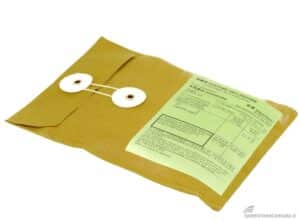
The pro forma invoice: what is it and when is it needed?
The pro forma invoice, or proforma invoice in English, is a necessary document for dispatch to Italy outside the European Union for non-commercial purposes. In fact, this document provides the customs authorities with important information on the shipment and ensures that your parcel arrives at its destination without any problems.
Drafting it correctly is not at all complicated, but care must still be taken to complete the invoice in all its parts. This article will provide you with important information on how the pro forma invoice works.
Index
What is a pro forma invoice?
The pro forma invoice is a document to be attached when sending a parcel for non-commercial purposes. It is required when shipping a parcel containing gifts or items for personal use outside the European Union, also understood as the EEC (European Economic Community). Through this form, the sender provides the customs authorities with important information about the contents of the shipment.
Since this is a document that accompanies international shipments outside the EU, all the data in it must be in English (or in the language of the destination country if necessary. English, however, is the standard). In particular, the document contains information on:
- Goods and what you are exporting: you should include as many details as possible about the items in the parcel or paller. Without precise information, customs agents may decide to hold the shipment for further checks, causing even considerable delays in the delivery of the parcel;
- Reason or what purpose it is being exported for: as mentioned, the pro forma invoice is drawn up when shipping a parcel for non-commercial purposes. Accordingly, it should be specified on the document that the goods are not being shipped for the purpose of being sold;
- Receiver or who the recipient of the shipment is: including all the details we will see later;
- Amount, what the value of the goods is: although an invoice is issued for non-commercial purposes, it is still necessary to state the commercial value of the contents of the parcel, i.e. the commercial value in case of sale.
Example of pro-forma invoice
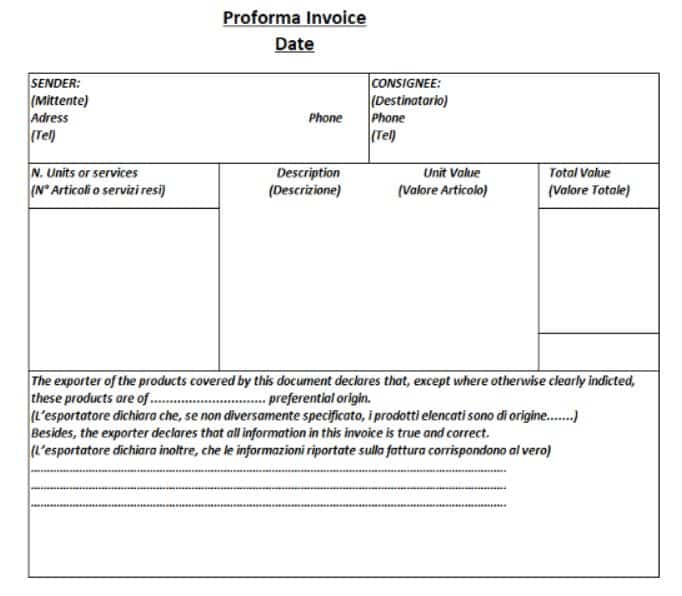
Download the facsimile pro-forma invoice here
To prepare the document more easily, you can download a copy to fill in here:
What are the differences between the pro forma invoice and the commercial invoice?
When shipping a parcel to a country outside the European Union, an invoice must necessarily be attached to the parcel to provide information about the shipment and its value. Incidentally, today the invoice is uploaded telematically at the time of the order, streamlining the booking process.
There are, however, two types of invoices: the pro forma invoice and the commercial invoice. It is important, therefore, to choose the one that suits the purpose of your shipment.
The invoice is absolutely necessary for customs clearance of the shipment; without it, the parcel could be held up in customs. In any case, if you have to send a parcel from Italy to friends, acquaintances or family in a non-EC country, it will be sufficient to attach the completed pro-forma invoice form telematically to the shipment.
The table below summarises the differences between invoice commercial and proforma.
What are the advantages of the pro forma invoice?
As we have seen, there are considerable differences between a pro forma invoice and a commercial invoice. Moreover, if possible, choosing to draw up the pro forma instead of a commercial invoice can have several advantages.
For example:
- the pro forma invoice can be modified without officially cancelling the previously issued one. This means that, in the event of errors, it will be very easy to rectify them;
- who issues the proforma will not have to pay taxes until a financial transaction actually takes place. This is particularly useful in the case of freelancers who issue a pro-forma invoice before they have even received a payment;
- only once payment has been received it will be necessary to issue a commercial invoice. Consequently, only with the actual invoice will you be responsible for paying charges and taxes, such as VAT.
How to fill in the pro forma invoice?
Filling out a pro forma invoice requires some time and attention to detail, but it is by no means complex. In fact, there are blank forms with all the fields to be filled in. Since, however, the pro forma invoice resembles a classic commercial invoice in many respects, you will need to pay attention to a few elements:
- ensure that the form clearly states the wording “pro forma invoicePrecisely because the two invoice models, the pro-forma and the commercial invoice are basically identical, it is important to differentiate between them and to clearly communicate to foreign customs authorities the type of invoice you are issuing in English, possibly at the very top and visible in the document.
- must include the following wording: “This document does not constitute a valid invoice for the purposes of the DpR 633 26/10/1972 as amended. The final invoice will be issued upon payment of the consideration (Article 6(3) of Presidential Decree 633/72).”
- must use a different numbering from the commercial invoice classical. As we have said, the numbering of the pro forma invoice need not be sequential.
- the invoice must be always compiled in English as it will be read in a foreign country. Furthermore, we do not accept handwritten invoices, but only typed and printed in digital form.
Data required to complete the pro forma invoice
The completion of the proforma requires the inclusion of various information in English about the exporter, the importer and the goods contained in the parcel. This information includes:
Sender and recipient data
- Sender (sender data)
- Namefirst name and surname
- AddressFull address
- Country: Country
- Phone numbertelephone number
- TAX IDVAT number (in the case of companies) or tax code (in the case of private individuals)
- Consignee (recipient's data)
- Namefirst name and surname
- TAX IDVAT number or tax code
- AddressFull address
- Country: Country
- Phone number and email address: telephone number and email address
- Sold todata of the importer, if the importer is different from the consignee
Shipping Information
- Shipment detais (shipment details)
- Invoice number: pro forma or commercial invoice number
- Dates: date on which the transaction was executed, as stated on the invoice
- Tracking: the consignment number on the consignment note
- PO: order number of the purchase, defined by the sender
- Terms of saleconditions of sale, e.g. who between sender and consignee bears the shipping costs, insurance and return terms
- Reason for exportreason for the shipment, including:
- Salt (sale) - to be excluded in case of pro forma invoice
- Gift
- Samples
- Repair
- Return
- Value information (shipment value):
- Invoice line total: value of contents except packaging
- Discount or rebate: discounts
- Invoice sub-total: value of the content once the discount has been applied
- Shippingshipping costs
- Insuranceinsurance cover
- Other: other expenses
- Total invoiceinvoice total
- Number of packages: number of packages shipped
- Total weight: total weight, including packaging
- Currency code: in the case of shipments from Italy, EUR
Package information and required documents
- Package details
- Unit: number of items
- U/M: unit of measurement used for the goods shipped (pieces, pairs etc.)
- Description of goods: description of the goods, the material, and its function
- Harm code: customs code of the article
- Country of origin: country of origin of products
- Unit value: value of each item
- Total value: value of all items
- Declaration statement
- The exporter of the products covered by this document declares that, except where otherwise clearly indicated, these products are of .............................. preferential origin.
(The exporter declares that, unless otherwise specified, the products listed are of European origin...... Here it must be specified whether the products are of European origin, i.e. put “European Economic Area” or abbreviated EU, or No. If not, put the geographical area of origin of the product). - Besides, the exporter declares that all information in this invoice is true and correct.
(The exporter further declares that the information on the invoice is true)
The declaration must be followed by date e signature of the sender.
- The exporter of the products covered by this document declares that, except where otherwise clearly indicated, these products are of .............................. preferential origin.
- Additional notes
- If you are sending a gift, we recommend that you specify: “Gift - Gift. Not for resale - Not for sale. No commercial value - No commercial value. Value for custom only - Value for import purposes only”.”
- In case of repair: “Item for repair”. And add the above wording immediately after “gift”.
Documents to be attached to the pro forma invoice
The pro-forma invoice is not in itself a sufficient document to ensure that the shipment is admitted to non-EU countries. In fact, additional copies of the pro-forma invoice are required, together with further documents. It must be remembered that today the invoice (whether pro-forma or not) and the Declaration of Free Export must no longer be attached manually to the parcel to be shipped in triplicate. Couriers from the end of 2024 will in fact prefer telematic uploads, otherwise there will be a surcharge for processing the paper.
Therefore, please have the following documents ready when ordering and upload them telematically correctly:
- pro-forma invoice. Pro-forma invoices must be signed and/or stamped if the stamp is available. If instead of a private individual it is a company, it would be appropriate to use company letterhead;
- valid identity document of the sender;
- sender's tax code or VAT number and it is a company;
- free export declarationthese must all be completed and signed in original. This will also be attached telematically at the time of ordering.
Final considerations: pro-forma invoice for non-EU shipments
As we have seen, any shipment outside the European Economic Community - EEC must be accompanied by an invoice, be it commercial or pro forma. The pro-forma invoice is suitable for cases where no financial transaction takes place between sender and consignee.
Thus, the pro-forma invoice is the congenial solution when sending gifts or personal items to friends, family or acquaintances outside the EU. In addition, the pro forma is also sufficient if you send samples or goods for analysis to a potential customer. In contrast, a commercial invoice will be required in the case of a sale.
It is important to follow the instructions in this article when filling out a pro-forma invoice and make sure that all information is correct and true. Failure to do so may result in the shipment being blocked leaving the EU or entering the destination non-EU country, causing delays in delivery.