Ultimate checklist for shipping fragile or valuable parcels abroad
Shipping fragile parcels always generates some anxiety: all it takes is insufficient padding, one too many empty spaces or a misplaced label for a porcelain vase, a screen or a musical instrument to arrive in pieces. The good news is that the problem almost never lies with the courier: in the vast majority of cases, damage occurs due to inadequate packaging.
In this guide you will find everything you need to sending a fragile parcel safely, from the step-by-step packaging to the choice of courier, from the right materials to the final checklist to be printed and kept on the workbench.
Summary
What is considered a fragile object?
Fragile items are any item that can break, splinter or be irreversibly damaged by shock, pressure or vibration during transport. Among the most common are:
- Glass and crystal: glasses, goblets, vases, bottles, mirrors, picture glasses
- Ceramics and porcelain: plates, cups, statuettes, sanitary ware, tiles
- Electronicslaptops, monitors, tablets, cameras, TV screens
- Musical instruments: guitars, violins, winds, percussion
- Works of Art: paintings, sculptures, prints mounted on glass
- Antiques and collectors' items
- Lighting: chandeliers, abat-jours, vintage neon
- Precision industrial components
What all these objects have in common is the need for a packaging designed to absorb shocks, not simply to contain the goods.
Why do fragile parcels get damaged? The 3 main causes
Before knowing how to prevent damage, it is useful to understand where it comes from:
- Impacts and falls during automatic sorting. Conveyors and sorting centres handle thousands of packages per hour. A parcel can fall 50-80 cm without anyone noticing.
- Blank spaces inside the box. If the object has freedom of movement, each vibration results in a repeated impact against the walls of the carton.
- Pressure from stacked packages. A fragile parcel may lie under other heavy parcels in the van or in the warehouse for hours.
Knowing these three causes allows you to design your packaging specifically for shipping fragile parcels: shock absorption, total immobilisation of contents, compression-resistant outer structure.
Materials: what to use (and what to avoid)
They work well:
High-thickness bubble wrap
It is the material par excellence for impact protection. It wraps around the part, creating an elastic layer that absorbs stress. Use bubbles large (ø 25-30 mm) for heavy and robust objects, bubbles small (ø 10 mm) for thin objects with sharp edges or delicate surfaces. Always secure bubble wrap with packing tape: do not leave it loose around the object.

Polyethylene foam and polyurethane foam
Rigid or semi-rigid foam is ideal for creating customised shapes around irregularly shaped objects (tools, electronic components, design pieces). It is more expensive than bubble wrap but offers superior protection against prolonged pressure when shipping fragile packages.
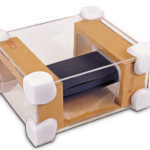
Protective corners
They protect the edges and corners of the outer box - statistically the most vulnerable points to impact - and distribute vertical pressure, preventing the fragile package from being crushed.
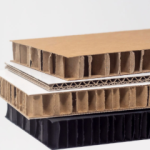
Honeycomb cardboard
Cardboard with an internal hexagonal cell structure, like bees' honeycomb. Resistant to vertical compression and capable of absorbing side impacts, it is used to wrap flat and fragile objects or as a separator between several pieces.
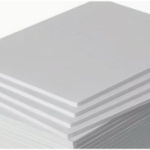
Rigid panels to distribute loads
Multilayer cardboard or corrugated plastic sheets inserted under, on top and on the sides of the object. They do not absorb shocks, but evenly distribute weight and pressure. Ideal for flat objects such as mirrors, screens and paintings.
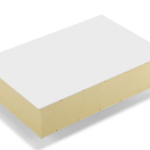
Air cushions and filler chips are only useful as a complement: they must not be the only protection, otherwise the object tends to sink.
Avoid newspapers or fillers that compress easily: lose volume and protection during the journey.
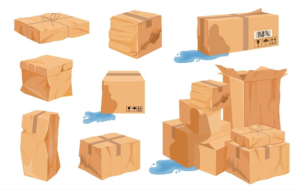
Avoid recycling cardboard boxes that have already lost their strength:
As you can see from the picture, stresses during travel can be varied, so if not properly prepared, the packaging will fail.
How to pack a parcel fragile: step-by-step procedure
Step 1 - Choose the right box
Always use a new boxrecycled boxes have already been subjected to stress and their strength is reduced. The box must be of the right formatNot too large (would force too much filling material with risk of sagging) nor too small (would compress the filling). Leave at least 5 cm space on all sides between the wrapped object and the walls of the carton.
For heavy (over 5-6 kg) or very delicate objects, choose cardboard with double wall.
Step 2 - Prepare and wrap the object
Before wrapping, take photos of the undamaged object and packaging at every stage: you will need them in the event of a complaint to the carrier.
Wrap the object with at least two layers of bubble wrap, starting from the base and covering all sides, edges and corners. Secure with tape. If the object consists of several pieces (e.g. set of glasses), wrap each piece individually before putting them together in the box: direct contact between fragile pieces, including upholstery, and pressure can cause micro-fractures.
Step 3 - The box-in-box method (double box)
For high-value objects - electronics, works of art, blown glass, musical instruments - the most reliable method is the double box (box-in-box):
- Place the wrapped object in a first dimensionally appropriate inner box.
- Fill the spaces with bubble wrap or foam until all movement is eliminated.
- Close the inner box with the “H” tape.
- Place the inner box in the centre of a larger outer box.
- Fill the gap between the two boxes with at least 5 cm of padding on all sides (bubble wrap, foam, chips).
- Close the outer box.
This system creates two independent protective barriers: even if the outer box suffers a violent impact, the inner box remains protected by the intermediate cushioning layer.
Step 4 - The “shake test”
Before finally sealing, Gently shake the box in all directions. If you hear any noise or perceive internal movement, open and add padding. The package must be completely silent and the contents motionless.
Step 5 - “H” Sealing”
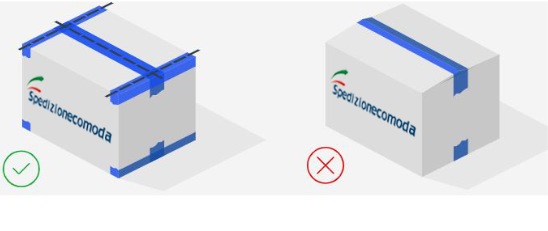
Close the box with the tape following the H“ technique”apply a central strip on the upper (and lower) flap, then two perpendicular strips on the sides joining the flap to the box walls. This reinforcement triples the strength compared to a single central strip and prevents accidental opening at the edges.
Step 6 - Labels and Documentation
- Apply labels “FRAGILE” e “HIGH” (up arrow) on all four vertical sides of the box and on the lid. Labels are no substitute for good packaging, but they reduce the likelihood of mishandling.
- Enter inside the box a sheet with the name and address of the sender and the addressee: if the outer label comes off, the parcel can still be identified.
- For shipments abroad, prepare the description of goods and the declared valueare required for the waybill and any insurance.
Quick instructions for sensitive categories
- Glass and ceramics (glasses, plates, china): wrap each piece individually, insert separators between one element and the other and adopt the double box. Impacts between neighbouring pieces are the most common cause of chipping.
- Electronics (TV, computers, cameras): whenever possible use the original manufacturer's packaging then placed in an outer box with additional padding. It avoids direct pressure on displays and blocks power supplies and accessories well.
- Mirrors and paintingsProtect the surface with rigid cardboard and foam, use corners for the perimeter and immobilise the frame. The double wall reduces the risk of cracks and vibrations.
- Musical instruments: within the case Fill in the gaps (especially around the handle), then place the case in an outer box with additional padding. Be careful of temperature changes and humidity.
- RTA“ furniture (in kit form)Reinforce the sides with rigid panels, protect the joints and separate the heaviest components. The contents must never move.
Type guide: how to pack specific fragile objects
Bottles and glass (wine, spirits, oil, perfumes)
Wrap each bottle individually with bubble wrap (at least 3 layers). Use cardboard separators between bottles: direct contact, even with padding, can be dangerous. Orient bottles vertically or horizontally evenly, never at an angle. Consider honeycomb foam dividers specifically for bottles, easily available online.
Ceramics, porcelain and crystal
Wrap each piece individually, paying attention to ears, handles and edgesare the most frequent breakage points. Place additional foam or crumpled paper in the inner cavities (e.g. cups, bowls). Use the box-in-box method for valuable pieces or complete sets.
Screens, monitors and televisions
If you still have the original box with the polystyrene templates, use it: it was specially designed. Alternatively, wrap the screen in large bubble wrap (at least 4-5 layers), then enclose it in custom-cut foam templates. Never leave the screen resting on its (cutting) thickness: it must remain flat.
Musical instruments
Inside the case, fill all empty spaces (around the neck, around the body) with foam or clean clothing until the instrument does not move even a millimetre. Then place the closed case in an outer box with at least 5 cm of padding on each side. Beware of temperature fluctuations: the glue of bowed instruments can crack in very hot or very cold environments.
Paintings and works of art
Protect the surface of the painting with a sheet of baking paper (not in direct contact with fresh oil paint), then with soft bubble wrap secured without touching the canvas. Reinforce the corners with cardboard or foam protectors. For sizes larger than 60×80 cm, consider a custom-made wooden crate.
When the object is of high value
- Pre-shipment photos of contents and packaging, numbering of packages and packing list.
- Ancillary servicesAdvanced traceability, signature on delivery and transport liability/insurance options; check what they cover and the exclusions for inadequate packaging.
- Customs documents and correct assessment good for the’supplementary insurance (declared value; some countries require commodity/HTS codes).
Insurance for sending fragile parcels: when is it worthwhile?
Most couriers offer basic cover on shipments (generally 50 to 100 euro), which rarely covers valuable fragile items. If you are shipping something worth more than 100-150 euros, always consider a’additional insurance on declared value.
With SpedizioneComoda you can add the insurance cover directly at the time of booking. Before activating the insurance, read the conditions: the cover is usually only valid if the packaging has been properly executed (which is why photos of the packaging, taken before shipment, are so important).
How to choose a courier for sending fragile parcels
Fewer passes = less risk. Therefore, for more delicate objects, it is preferable:
- Choose the express service instead of the standard: reduced time means less sorting in between.
- Prefer couriers with direct hub on the route (e.g. DHL or UPS for shipments within Europe).
- Avoid shipments during peak periods (Black Friday, Christmas, year-end) when high volumes increase the likelihood of hasty handling.
With SpedizioneComoda you can compare the rates and times of all available couriers for your destination in real time, choosing the one that best balances speed, reliability and cost.
How much does it cost to ship a fragile parcel?
The cost of shipping a fragile object is no different from that of a normal shipment of the same size and weight: couriers do not charge special rates for delicate items. The cost difference, if anything, concerns:
- I packaging materials (bubble wrap, foam, double-walled boxes): for professional packaging you spend on average between 5 and 20 euros more than for standard packaging.
- The possible additional insurance on declared value.
- The service express instead of the standard, if you want to minimise the sorting steps.
To get an instant quote on your shipment, use our online calculator: enter size, weight and destination and immediately compare the rates of the major couriers.
→ CALCULATE QUOTE
Common mistakes to avoid for parcels
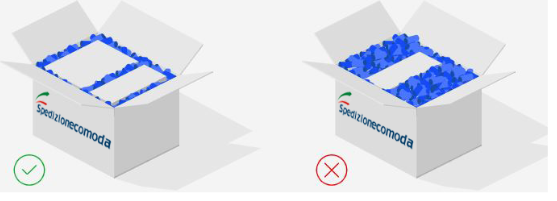
Re-using “tired” boxes” or too big (they collapse and crush easily).
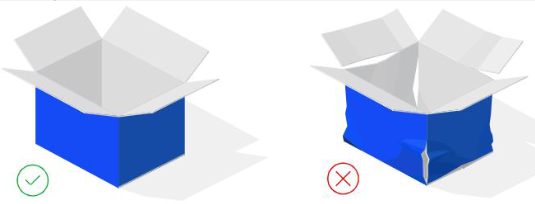
Fill with only paper or light chips,
or leave large gaps. If paper and light chips are used as the only protection, they compress during transport and the object remains free to move.
Forgetting to affix the “H” tape”
and flap reinforcements. If the flaps open, the box loses integrity.
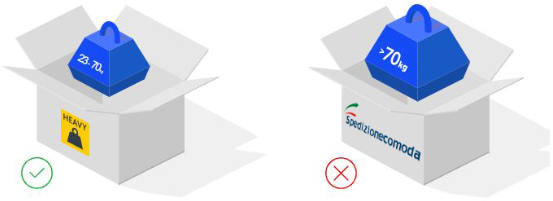
Heavy packages:
We accept parcels up to 70 kg even without pallets; however, for weights over 30 kg can be applied supplements. For security reasons, apply a label “HEAVY” on all the hills that exceed 23 kg.
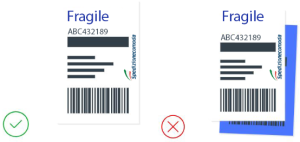
Relying on the “Fragile” label instead of technical packaging
The label does not compensate for poorly designed packaging. Also, make sure it is clearly legible and not superimposed on other old labels already in the box.
Objects touching each other:
is risky as it creates internal shocks.
And for Pallets....
Stacking “in columns”
(or brick only if needed)
Vertical, columnar stacking provides maximum resistance to crushing. If the contents are rigid and the layers “play” a bit, you can alternate the brick pattern to increase transverse stability, while still avoiding protrusions.
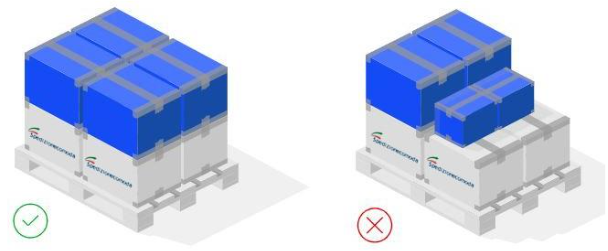
No protrusions beyond the perimeter
Packages must fit in perfectly in the perimeter of the pallet: pallets with overhangs are not accepted. Protrusions are easily damaged during handling and prevent proper stacking in storage and in transit.
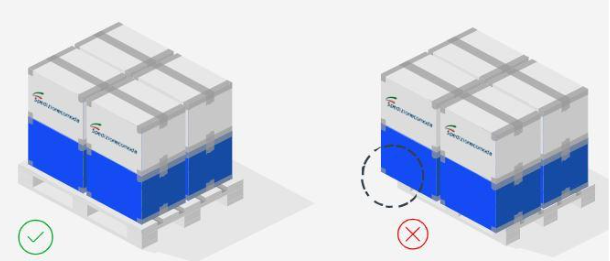
Flat and stackable top
The top of the pallet must be flat, rigid and stackable. Non-stackable pallets (with uneven or “pointed” profiles) result in extra charges and increase the risk of damage because they cannot be stored safely in columns.
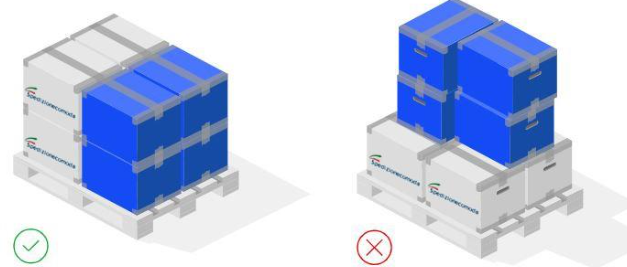
Strapping and/or stretch film: also attach to pallet
It clamps the load with two crossed straps (passed around the packages and pallet skids) and uses stretch film to wrap the entire volume including the base. This way the load works as a single body and does not slip during bumps and braking.

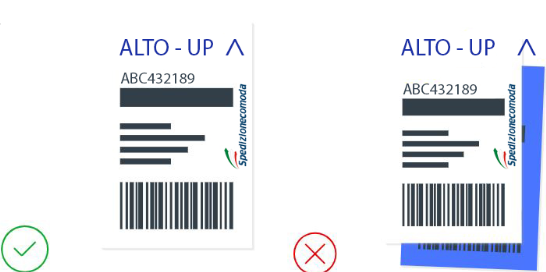
Clearly visible label
on the side (not on top)Apply the labels to the sides of the pallet, never on the top: another pallet could be stacked on top and cover them. Shipping tipComoda.com:
- Per pallet stackable, insert a copy of the label also inside one of the hills.
- Per pallet non-stackable with irregular goods, apply the label directly on the object (if you wrap with film, label before wrapping) and use Do Not Stack“ cones/indicators” clearly evident
Operational checklist (short but comprehensive)
- Before we begin: take photos of the object and packaging, define the value and check whether a additional coverage. For foreign countries prepare goods description and, when required, HS code.
- Ready-made materials: box new and robust, bubble wrap/foam, rigid surface panels, corner panels, quality tape and transparent envelope for documents.
- Correct packaging: wrap, immobilises, eliminates gaps; if necessary use the box-in-box. Do the “shake test”: if you feel movement, add protection.
- Closure and documents: seals a “H” above and below; apply FRAGILE/HIGHER labels; insert sender/receiver clearly legible and attach customs documents.
- Delivery and tracking: activates the notifications, choose the signature on delivery and keep receipts and photos until delivery.
📋 PDF list of critical points to check before sending:
Download the check list in PDF
Frequently Asked Questions on Shipments of Fragile Objects
Do “Fragile” labels guarantee special treatment?
No, unfortunately not. Labels are useful for informing staff of the presence of delicate contents, but in automated sorting centres, packages pass on conveyor belts regardless of any writing. The only real guarantee is a package designed to withstand impact, no matter how it is handled.
What happens if my fragile object arrives damaged?
The first thing to do is to document everything: photograph the outer package before opening it (to check for visible external damage), then the inner packaging and finally the damaged item. Keep all packaging material: in many cases the courier company requires to see it to assess the claim. Then contact the courier or our customer service within the prescribed time limit (usually 7 days after delivery for visible damage, 14 for hidden damage).
Can I ship fragile items abroad?
Yes. For EU countries (such as Belgium, France, Germany, Spain) no additional customs procedures are required. For non-EU countries (e.g. USA, UK, Switzerland) a detailed description of the content and declared value is required for customs declaration. In both cases, the packaging rules are the same.
Can I ship fragile high-value items such as works of art or antiques?
Yes, but for high-value items (over EUR 500-1,000) we advise you to contact us for a customised quote: there are dedicated transport solutions with manual handling that provide a higher level of protection than standard express shipments.
Is the express service really safer for the fragile?
In principle, yes, because the parcel undergoes fewer sorting steps and stays in transit for less time. This is not an absolute guarantee, but combined with proper packaging it significantly reduces the risk of damage.
Do I have to declare that my parcel contains fragile items?
It is not compulsory in the strict sense, but it is strongly recommended: applying FRAGILE labels and indicating this in the description of the waybill increases the likelihood of careful handling and simplifies the possible claims procedure in the event of damage.