Taric Code
TARIC code: what it is, how to find it and how to use it to ship abroad
If you have to send a parcel outside the European Union - to Australia, the USA, Japan or any other non-EU country - sooner or later you come across the TARIC code.
It is one of the compulsory data in customs documentation, and is often the main cause of parcels stuck in customs or unexpected penalties.
In this guide you will find everything you need: what the TARIC code is, how it is structured, where to find it, how to look for it on AIDA, what mistakes to avoid and when you really need it - with practical examples of Italian products among the most shipped abroad.
What is the TARIC code
TARIC stands for Community Integrated Tariff (Integrated Tariff of the European Communities). This is the system used by the European Union to classify all goods in trade with non-EU countries.
In practice, the TARIC code is a 10-digit number which uniquely identifies each type of goods. Thanks to this code, the customs authorities know exactly:
- what rate of duty apply to imported goods
- if they exist restrictions or prohibitions for that product category
- if they are required authorisations or licences specials
- if they apply anti-dumping duties or safeguard measures
The TARIC was established by the Regulation (EEC) No 2658/87 of the Council and is managed by the European Commission, which continuously updates it. In Italy, the national version can be consulted through the AIDA of the Customs and Monopolies Agency, which integrates European data with Italian tax specifications (VAT, excise duties).
💡 In summaryThe TARIC code is the “tax code” of your goods for European customs. Without it, or with an incorrect code, your shipment risks being blocked, incorrectly taxed or returned to sender.
The structure of the TARIC code: 6 to 10 digits
The TARIC code does not start from scratch: it is built on progressive levels of classification, each of which adds more detail about the goods.
[ 2 digits: Chapter ] → [ 4 digits: Heading ] → [ 6 digits: HS subheading ] → [ 8 digits: Combined Nomenclature ] → [ 10 digits: TARIC ]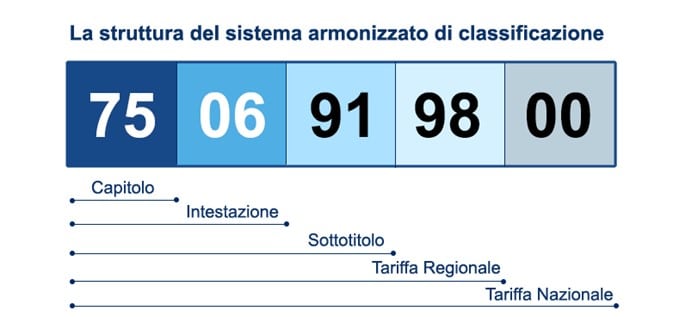
📌 Example:
Let's see it in detail with a concrete example - a laptop:
| Level | Figures | Code | Meaning |
|---|---|---|---|
| Chapter | 2 | 84 | Machines and mechanical appliances |
| Entry | 4 | 8471 | Automatic data processing machines |
| HS subheading | 6 | 8471.30 | Portable machines, weight ≤ 10 kg |
| Combined Nomenclature | 8 | 8471.30.00 | EU breakdown by statistics and duty |
| Full TARIC | 10 | 8471.30.00.00 | EU-specific subheadings + additional measures |
The first 6 digits: the Harmonised System (HS)
The first six figures are derived from the Harmonised System (HS), an international standard developed by the World Customs Organisation (WCO) and adopted by over 200 countries. This means that the first six digits of the TARIC code are the same worldwide: a laptop has the same HS prefix in Italy, Japan and Australia.
The AS is divided into:
- 21 sections (major product categories)
- 99 chapters (e.g. Chapter 84 = machinery)
- Entries (4 digits) and subheadings (6 digits)
Numbers 7-8: the Combined Nomenclature (CN)
The figures 7 and 8 form the Combined Nomenclature, specific to the European Union. They are used for:
- the Intrastat declarations (intra-EU trade)
- the determination of the common customs duty EU
- European foreign trade statistics
Figures 9-10: the actual TARIC
The last two digits are the TARIC digits proper. They are used for goods subject to:
- variable duty rates according to country of origin
- anti-dumping or countervailing duties
- tariff suspension measures
- tariff quotas
In many cases these last two digits are “00”, but it is essential to always check, because a wrong “00” can cost you additional duties or the blocking of the shipment.
TARIC, HS and Combined Nomenclature: the differences
These three systems are often confused. Here is the quick distinction:
| System | Figures | Used where | Managed by |
|---|---|---|---|
| HS (Harmonised System) | 6 | Worldwide (200+ countries) | WCO (World Customs Organisation) |
| NC (Combined Nomenclature) | 8 | European Union only | European Commission |
| TARIC | 10 | EU only, non-EU import/export | European Commission + Customs Agency EN |
When shipping from Italy to a Non-EU country, you need the 10-digit TARIC code for the Italian customs declaration. The country of destination will use its HS code or equivalent to handle the import.
How to find the TARIC code on AIDA (step by step)
AIDA (Automazione Integrata Dogane Accise) is the official portal of the Italian Customs and Monopolies Agency. It is the most comprehensive tool for finding the correct TARIC code because it also shows VAT and excise duties applicable in Italy.
Step-by-step procedure
Step 1 - Go to aidaonline7.adm.gov.it
Step 2 - In the main menu, select “Nomenclature”
Step 3 - Click on “TARIC” → then on “TARIC Index”
Step 4 - Browse the 21 sections or use the search bar to search your goods by keyword (e.g. “shoes”, “oil”, “car”)
Step 5 - Identify the section and the chapter relevant to your goods
Step 6 - Expand the headings and subheadings until you find the one that exactly describes your product
Step 7 - Click on the code to view all applicable measures: duties, VAT, excise duties, restrictions, quotas
⚠️ AttentionAIDA shows updated data in real time. If you are unsure of the classification, consult an customs officer or a customs agent before completing the documentation.
Alternative: keyword search
On the AIDA portal you can also search for the code for textual description. Enter the name of the product in Italian (e.g. “leather shoes”) and the system proposes the corresponding entries. This is useful as a starting point, but the final classification must always be checked in the TARIC hierarchical structure.
How to find the TARIC code on the European DDS2 portal {#dds2}
The DDS2 portal of the European Commission (ec.europa.eu/taxation_customs/dds2/taric) is the central EU database. Compared to AIDA:
- shows the common European tariff measures
- is available in all EU languages, including Italian
- does not show national tax specifications (Italian VAT, excise duties)
When to use DDS2if you want to check the EU tariff measures applicable to your goods regardless of the EU country of departure, or if you are looking for information on anti-dumping duties and tariff quotas.
When to use AIDAif you ship from Italy and want to get the full picture including VAT and excise duty.
Practical examples: TARIC codes for common Italian products
Here are some TARIC codes frequently used for Italian products exported abroad. Use them only as a starting pointThe final classification always depends on the specific characteristics of your product.
| Product | TARIC code (indicative) | Notes |
|---|---|---|
| Durum wheat semolina pasta (dry, not stuffed) | 1902.11.00.00 | Category processed cereals |
| Extra virgin olive oil | 1509.10.10.00 | Varies according to acidity and packaging |
| Bottled still wine (< 2 litres) | 2204.21.93.00 | Varies by denomination and volume |
| Leather shoes (women, heels > 3 cm) | 6403.51.05.10 | Varies by material and type of sole |
| Cotton clothing (T-shirts for men) | 6109.10.00.10 | Varies by material and genre |
| Laptop (weight ≤ 10 kg) | 8471.30.00.00 | Laptop standard |
| Sunglasses | 9004.10.18.00 | Varies by type of frame |
| Ceramic tableware (plates, cups) | 6911.10.00.00 | Varies by type of porcelain |
⚠️ ImportantThese codes are indicative. The correct TARIC classification requires an analysis of the specific characteristics of the goods (material, function, intended use, weight, processing). In case of doubt, always consult a customs officer.
When the TARIC code is needed in shipments
The TARIC code not needed for shipments within the European Uniongoods move freely between Member States without customs formalities.
Become mandatory in the following cases:
✅ Export from Italy to Non-EU countries
Every time you send a parcel outside the EU (Australia, USA, Japan, UK post-Brexit, Switzerland, etc.) you must indicate the TARIC code on the pro forma invoice or commercial and in the customs export declaration. Without this information, customs can block the shipment or request integrations.
✅ Import into Italy from non-EU countries
If you receive goods from abroad (e.g. purchases from Asian suppliers), the TARIC code determines the duties you will pay when entering Italy/EU.
✅ Intrastat declarations (with CN code)
For intra-EU trade of significant value, companies must submit the Intrastat declarations, They require the NC code (8 digits), which is the basis for TARIC.
❌ Not needed for intra-EU shipments
If you ship from Milan to Berlin or by Rome in Madrid, you do not have to fill out customs documents and TARIC is not necessary.
Frequent errors in TARIC classification
These are the most common errors that cause customs blocks, penalties or incorrect duty payments:
| Error | Consequence | How to avoid it |
|---|---|---|
| Use only 8 digits (NC) instead of 10 (TARIC) | Incomplete customs declaration, possible rejection | Always check the 10 digits on AIDA or DDS2 |
| Copy code from previous invoices without verification | TARIC updates every year: the code may have changed | Consult AIDA for each new shipment |
| Classifying goods too broadly | Wrong duties, possible dispute | Analyses specific product characteristics |
| Do not check for anti-dumping duties | Unforeseen costs for the recipient | Always check the goods card on AIDA or DDS2 |
| Enter “00” at the last two digits without verification | Possible error if specific sub-items exist | Never assume that the last 2 digits are “00”.” |
| Use the HS code of the destination country | Different codes between EU and non-EU countries | For the Italian declaration, always use TARIC/NC |
Who is responsible for the TARIC code?
The responsibility for correct classification lies with the person who signs the customs declaration:
Exporters and importers are the directly responsible parties. If the TARIC code is wrong on the invoice or customs declaration, they are liable for any penalties or unpaid duties.
Freight forwarders and customs brokers may support in classification, but the ultimate responsibility always remains with the owner of the goods.
With ShippingComfortable, During the booking process, we guide you through the compilation of customs documentation - pro-forma invoice, free export declaration and TARIC code entry - reducing the risk of errors that can hold up your shipment.
👉 [Calculate quote for your international shipment →]
TARIC updates: what to know
The TARIC code is not static. It is subject to two types of update:
Annual structural update (1 January)
Every year, on 1 January, the Combined Nomenclature is revised. Some entries are created, some are deleted, and some have their description changed. This means that a code valid in 2024 may not be correct in 2025.
What to doFor recurring shipments of the same product, check the code at least once a year on AIDA, especially at the beginning of the year.
Real-time updates
Tariff measures (anti-dumping duties, quotas, suspensions) are continuously updated on the official portals. In times of international trade tensions (e.g. US-EU duties), changes can be frequent and significant.
FAQ - Frequently asked questions about the TARIC code
What is the TARIC code and what is it for?
The TARIC code is a 10-digit number used by the European Union to classify goods in trade with non-EU countries. It is used to determine the applicable customs duties, restrictions, if any, and regulatory requirements for each product category.
Is the TARIC code compulsory for all international shipments?
It is only mandatory for shipments to non-EU countries (outside the EU). For shipments within the EU it is not required, as goods circulate freely without customs formalities.
Where can I find the TARIC code for my product?
The official Italian tool is the AIDA portal of the Customs and Monopolies Agency (aidaonline7.adm.gov.it). Alternatively, you can use the European Commission's DDS2 portal. Both are free and accessible online.
What happens if I enter the wrong TARIC code?
The risk is twofold: either you pay higher duties than necessary, or you pay less than necessary and risk customs penalties. In both cases, the shipment may be detained for investigation. Incorrect classification may also result in the goods being returned to the sender at the consignee's expense.
How many digits does the TARIC code have?
10 digits in total: the first 6 are from the Harmonised System (international standard), digits 7-8 form the EU Combined Nomenclature, digits 9-10 are the specific TARIC subheadings.
Is the TARIC code the same in all countries?
No. The first 6 digits (Harmonised System) are uniform in over 200 countries. The subsequent digits (7-10) are EU-specific. The country of destination will use its own customs classification system to handle the import.
How often is the TARIC code updated?
The basic structure (Combined Nomenclature) is updated every 1 January. Tariff measures (duties, quotas, restrictions) are updated in real time on the official portals. It is always advisable to check the code before each important shipment.
Do I need a customs broker to find the TARIC code?
For simple, well-identifiable products (e.g. clothing, consumer electronics, packaged foodstuffs) you can find the code yourself on AIDA or DDS2. For complex, composite products, with special processing or subject to special regulations, the support of a customs broker is strongly recommended.
What is the difference between TARIC code and HS code?
The HS (Harmonised System) code is international and consists of 6 digits. TARIC is European and consists of 10 digits: it includes the HS code as a base, adding EU specificities in the last 4 digits.