Incorrect packaging: the 10 most common mistakes (and how to avoid them so your parcel doesn’t get lost)
Incorrect packaging is the number one cause of parcels being damaged in transit — and in most cases, the responsibility lies with the sender, not with the express courier. In this guide, you’ll find the 10 most common packing mistakes, how to avoid them, and a handy checklist for every type of product. If you’d like the full guide on how to pack a parcel, read also how to pack a parcel for posting
Why incorrect packaging is a serious problem
During transit, a parcel is loaded and unloaded on average 5–8 times between collection and final delivery. It is stacked with other parcels and may be subjected to lateral impacts, pressure from above, vibrations from the vehicle, and fluctuations in temperature and humidity. Inadequate packaging cannot withstand this journey.
The practical consequences of incorrect packaging are:
- Damage to contents (broken, crushed or wet items)
- Loss of contents (box opening during transit)
- Refusal of the consignment by the courier
- Failed delivery due to an illegible or detached label
- Loss of entitlement to a refund in the event of damage
⚖️ The’Article 1693 of the Civil Code It stipulates that the courier is liable for the loss of or damage to the goods — unless it can be proved that the damage resulted from an inherent defect in the goods, their nature or inadequate packaging by the sender. In other words: if you pack it poorly, the courier won’t pay.
The 10 most common packaging mistakes
❌ Mistake 1: using a box that is too big or too small
The box must be proportionate to its contents. A box that is too large leaves empty space inside: the contents will shift during transport and be damaged by impacts. A box that is too small cannot be sealed properly and is likely to give way under external pressure.
⚠️ The golden rule: the box must be slightly larger than the item — large enough to allow for 5–8 cm of padding on all sides. No more, no less.
✅ Choose a rigid double-layer corrugated cardboard box for domestic shipments, or a triple-layer box for international shipments or for heavy items (>10 kg).
❌ Mistake 2: reusing old boxes without checking their strength
Cardboard boxes lose their strength every time they get wet, are compressed or folded. A box that looks intact may have weakened walls and could give way under the weight of other packages stacked on top of it.
- Reuse your Amazon or supermarket box to post fragile or heavy items
- Please do not remove old shipping labels (they cause confusion for the courier)
✅ If you’re reusing a box: press firmly on the sides — if they give way, don’t use it. Remove or completely cover any previous labels.
❌ Error 3: Insufficient or missing padding
This is the most common mistake made when packing items incorrectly, and it is the one that causes the most damage. Without adequate padding, the contents will hit the sides of the box directly in the event of a knock. Even the sturdiest box cannot protect an unpadded item.
Padding materials and when to use them:
|
Material |
Ideal for |
Notes |
|
Pluriball (bubble wrap) |
Fragile items, glass, ceramics |
Wrap each piece separately; with the bubbles facing inwards |
|
Expanded polystyrene |
Electronics, measuring instruments |
High impact resistance; leaves no gaps |
|
Kraft paper / packaging paper |
Clothing, books, light items |
Economical and recyclable |
|
Packing peanuts (pellets) |
Filling in the gaps |
Do not use on their own: they lose their effectiveness over time |
|
Airbags (air pillows) |
Fulfillment, e-commerce |
Lightweight and effective for large volumes |
|
Foam sheets (foam) |
Precision electronics, jewellery |
Surface protection and scratch resistance |
💡 The shake test: once you’ve closed the box, give it a gentle shake. If you can hear anything moving, add more padding until the contents are secure.
❌ Error 4: failing to separate objects internally
If you are sending several items in the same box, each one must be wrapped separately and must not touch each other or the sides of the box. Items that touch each other during transit will knock against one another, causing damage that the external padding cannot prevent.
✅ Between each item: at least 3–5 cm of padding. Between the outermost item and the side of the box: at least 5 cm.
❌ Error 5: Weak or incorrect sealing
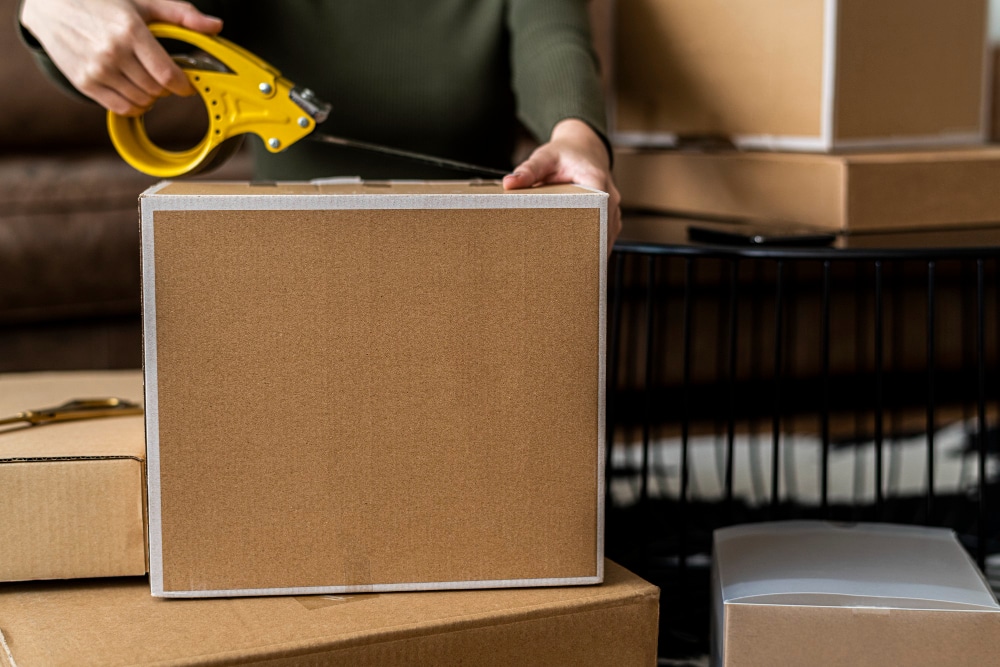
Not all packing tape is the same. Clear office tape isn’t suitable for posting: it comes unstuck when exposed to moisture and can’t support the weight. The way you seal the box is just as important as the box itself. To avoid packing your parcel incorrectly, follow these steps:
The correct method — H-clamp:
- Seal the bottom of the box with a strip of tape running along the entire length of the central seam
- Apply a strip perpendicular to each side (forming an H)
- Repeat the same procedure on the top cover
- For heavy parcels (>5 kg): secure them by wrapping a strip of tape around the entire box
✅ Use brown or transparent polypropylene (PP) packing tape, with a minimum width of 48 mm. For heavy items: fibreglass-reinforced tape.
❌ Error 6: label is misaligned, illegible or unprotected
The shipping label is the parcel’s identity document: without it, the parcel cannot be delivered. A label that is torn, faded or stuck to an edge can cause delays or result in the parcel being lost for good.
- Place the label on one of the edges or corners of the box
- Cover the barcode with adhesive tape (the barcode will not be read by the scanner)
- Print the label on ordinary, non-adhesive paper and stick it down with sticky tape — it will come off if it gets damp
✅ Place the label on the largest, flattest surface (usually the lid). Cover the entire label with clear tape, ensuring the barcode remains legible. Always include a copy of the label inside the parcel as well.
❌ Mistake 7: ignoring the volumetric weight
Courier companies calculate the cost not only on the basis of actual weight but also on volumetric weight. A large but light parcel may cost more than you expect. This is particularly true for international shipments, where the volumetric weight has a significant impact on the final price.
Standard formula for volumetric weight: Length × Width × Height (cm) ÷ 5,000 = volumetric weight in kg
💡 Always use the smallest box that provides adequate protection. Do not pack a 200g item in a 50×50×50 cm box: the volumetric weight would be 25 kg.
❌ Error 8: no internal stock label
If the external label comes off or becomes illegible during transit, the parcel ends up in the courier’s “undeliverable” depot. The only way to retrieve it is to have an internal label showing the sender and recipient.
✅ Always include a note inside the parcel with: the sender’s name and address, the recipient’s name and address, and the order number or reference number. It only takes 30 seconds and can make the difference between a parcel being recovered and one being lost for good.
❌ Error 9: Incorrect packaging for fragile items
“The word ”Fragile’ written on the box is not enough — and it offers no legal protection. The courier is required to handle parcels marked as fragile with care, but the real protection must come from the internal packaging.
Courier guidelines for fragile items:
- Any fragile item must withstand a drop from a height of 1 metre without being damaged — this is the standard test used by couriers to assess liability in the event of a claim
- Fragile items must not touch the sides of the box: there must be at least 5 cm of padding on all sides
- Glasses, wine glasses, bottles: wrap each one individually in bubble wrap, stand them upright (never lay them flat), and fill any empty space
- Mirrors, paintings, sheets of glass: these require wooden crates or reinforced corner protectors — a standard cardboard box is not sufficient
⚠️ If you pack a fragile item poorly and it breaks, the courier may refuse to issue a refund on the grounds of inadequate packaging (Article 1693 of the Civil Code). Always take a photo of the packaging before sealing the parcel.
❌ Error 10: dangerous goods that are incorrectly packaged and do not comply with the regulations
Some products require specific packaging for safety reasons: lithium batteries, flammable liquids (perfumes, nail varnish), aerosols and chemicals. Sending these items without the correct packaging is not just a mistake — it may be illegal and will result in the shipment being rejected immediately.
- Perfumes and cosmetics containing alcohol: require shock-resistant packaging and often IATA classification for air freight
- Lithium batteries: IATA rules specific to charge status and quantity — always check before shipping
- Liquids in general: Each container must be sealed and placed in an airtight bag inside the parcel
- Classified dangerous goods: require UN-certified packaging — cannot be sent via standard courier services
→ Full list Prohibited and restricted items for deliveries.
How to pack a parcel properly: a 7-step guide
- Choose the right box: sturdy, the correct size, and free from any previous damage
- Seal and reinforce the base with packing tape (H-method)
- Place a layer of padding on the bottom (at least 5 cm)
- Wrap each item individually in bubble wrap or foam
- Fill the gaps with filler — the contents must not move
- Insert the spare internal label
- Close the lid and seal it with tape (H-method) — apply and secure the outer label
💡 Final test: hold the box by one corner and give it a shake — if you can hear something moving around, open it and add some padding. If it holds up, you’re all set.
Packaging by product type: a quick guide
|
Product type |
Recommended materials |
Specific notes |
|
Fragile items (glass, ceramics) |
Bubble wrap + double-layered box |
At least 5 cm of padding on all sides; write ‘FRAGILE’ |
|
Electronics (smartphones, laptops) |
Foam sheet + bubble wrap + anti-static |
Use anti-static bags for circuits; avoid packing peanuts coming into contact with them |
|
Clothing and textiles |
Waterproof bag + kraft paper |
Protect from damp using a sealed plastic bag |
|
Books and documents |
Sturdy cardboard + bubble-wrap envelope |
Place the book face down; corners protected |
|
Packaged food |
Airtight container + rigid box |
Check expiry dates; loose food items CANNOT be posted |
|
Liquids (perfumes, wines) |
Waterproof bag + bubble wrap + box |
Each bottle is checked individually; leak test carried out before sealing |
|
Heavy items (>10 kg) |
Triple-layer box + reinforced tape |
Spread the weight evenly; do not exceed the courier’s weight limits |
|
Plants and seeds |
Certified packaging + phytosanitary certificate |
Shipment subject to restrictions — please check first |
Packaging materials: what to buy
|
Material |
Approximate cost |
|
PP packing tape (48mm × 66m) |
€2–4 per roll |
|
Bubble wrap (50cm × 10m) |
€8–15 |
|
Double-layer cardboard box (various sizes) |
€1–5 per box |
|
Kraft wrapping paper (10 kg) |
€15–20 |
|
Padded bubble wrap envelopes (various sizes) |
€0.20–1 per packet |
|
Packing peanuts (50 litres) |
€10–15 |
|
Foam sheet (0.5 m × 1 m) |
€2–5 |
|
Waterproof envelopes (set of 20) |
€5–10 |
Guide prices for online purchases. For frequent deliveries, it is worth buying in bulk.
What to do if a parcel arrives damaged due to incorrect packaging
If the recipient tells you that the contents arrived damaged, the courier’s first question will be: “Was the packaging adequate?”
How to protect yourself before posting:
- Take a photo of the item in its original condition before packing it
- Take a photo of the finished packaging with all the layers visible
- Take a photo of the sealed parcel with the label attached
- Keep the photos — they’re your evidence in the event of a complaint
💡 If the packaging was correct and the damage occurred during transit, you are entitled to a refund. Read the full guide at Non-delivery: what to do and how to make a complaint.
FAQ — Incorrect packaging and dispatch
How much bubble wrap should I use for a fragile item?
At least 3–4 layers of bubble wrap wrapped around the item, with the bubbles facing inwards. Between the wrapped item and the side of the box: at least 5 cm of additional padding. For very fragile items (blown glass, porcelain): double the number of layers.
Can I use newspaper instead of bubble wrap?
Yes, for non-fragile items such as books or clothing. For fragile items, it is not sufficient: the paper compresses under pressure. Use it only to fill gaps, not as the main padding.
Is the courier liable if the parcel arrives damaged?
It depends on the packaging. Article 1693 of the Civil Code stipulates that the courier is liable — unless it can prove that the damage was caused by inadequate packaging on the part of the sender. If the packaging was correct and documented with photographs, you are entitled to a refund. If it was inadequate, the courier may reject the claim.
How many labels do I need to put on the parcel?
One on the outside (on the largest, flattest surface) + one spare on the inside. The outer label must be secured with clear tape across its entire surface, ensuring the barcode remains fully legible. Never apply labels to edges or corners.
Can I send liquids via an express courier?
It depends on the type of liquid. Common liquids (shampoo, wine, perfumes) are generally permitted provided they are packed correctly: each container must be placed in an airtight bag and wrapped in bubble wrap. Flammable liquids (acetone, solvents) and aerosols require special procedures or are prohibited on flights.
How do you pack a bottle of wine for posting?
Wrap each bottle individually in 3–4 layers of bubble wrap. Place it upright in a cardboard divider or a box designed specifically for bottles. Fill all the gaps with padding. DO NOT use flimsy boxes: the bottles are heavy and require reinforced double-walled boxes.
If I write “fragile” on the box, will that protect me in the event of damage?
Not legally. The word ‘FRAGILE’ is an operational recommendation but does not provide legal protection. The courier may contest the claim if the internal packaging was inadequate, regardless of what is written on the outside.