How to Measure a Parcel for Postage: A Practical Guide with a Formula and Calculator
Measuring a parcel before posting it is the first step towards obtaining an accurate quote and avoiding any surprises on your invoice. If the dimensions you enter into the calculator do not match the parcel’s actual dimensions, the courier may apply a volumetric excess weight — that is, to charge you the difference when you collect or receive the item.
In this guide, you’ll find everything you need: the tools, a step-by-step guide, the formula for volumetric weight, and the maximum dimensions accepted by the main couriers. By following this guide, you’ll know exactly how to measure a parcel for dispatch in just a few minutes.
📐 Why Measurements Really Do Matter
The parcel’s dimensions serve two key purposes:
- Get an accurate quote. Courier companies calculate the price based on either the actual weight or the volumetric weight — they charge whichever is higher. If you enter incorrect dimensions, the quote you see online will not match what you actually pay.
- Protect the contents. A parcel that is the right size, with adequate internal padding, arrives undamaged. A parcel that is too large for its contents gets squashed during transit.
For the courier, these measurements are used to plan the loading of vans and aeroplanes, and to calculate the correct price based on the space occupied — not just the weight on the scales.
🧰 The Tools You Need
Before measuring the parcel, please have the following ready:
- Tape measure or ruler — at least 50 cm, preferably rigid, to measure the sides accurately
- Libra — a parcel scale (more accurate) or a standard bathroom scales
- Pen and paper — to note down the length, height, depth and weight before entering them into the calculator
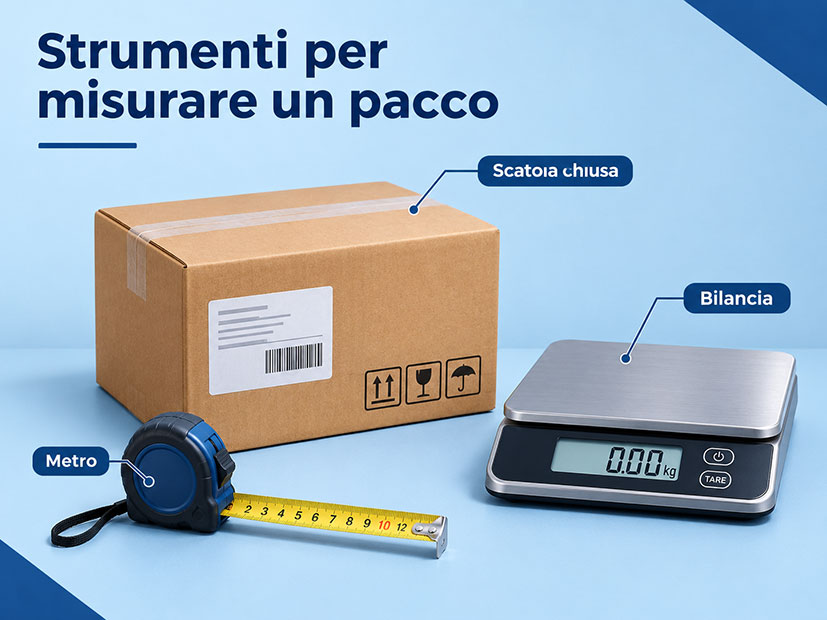
⚠️ Important: Always measure the parcel once it has been sealed and packed, not just the contents on their own. The weight of the packaging (box, bubble wrap, tape) affects the total and must be included in the quote. Having everything ready before you start makes it much easier to measure a parcel for posting correctly first time round. |
📏 How to Measure Length, Height and Depth
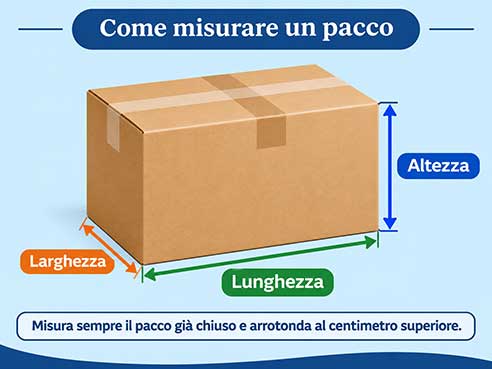
A standard parcel is shaped like a rectangular prism. The three measurements you need are:
- Length (L) — the longest side of the parcel, as seen from the front
- Depth (P) — the second longest side (how “deep” the parcel is, when viewed from the side)
- Height (H) — the shortest side, that is, the vertical side from the base to the highest point
Always measure in centimetres, rounding up to the nearest centimetre. If the parcel is 43.2 cm, write 44 cm. Couriers always round up.
💡 Tip: If the parcel is not perfectly rectangular (crushed corners, protrusions), always measure the longest dimension of each side. |
⚖️ Bulk Weight: What It Is and How to Calculate It
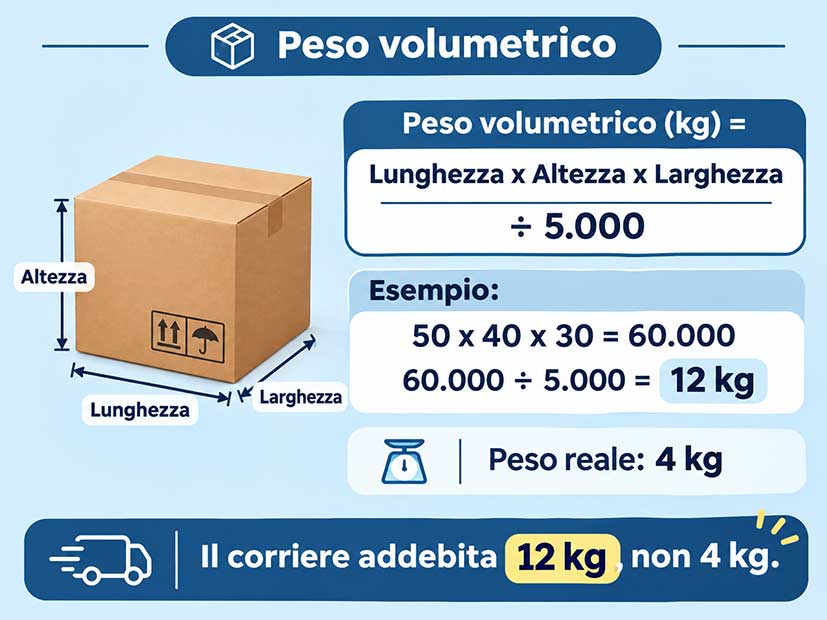
The volumetric weight (or volumetric weight) measures the space a parcel takes up in a van or on a plane, regardless of how much it weighs. A large but light parcel — such as a polystyrene box — takes up a lot of space but weighs very little. Couriers apply the volumetric weight if it is greater than the actual weight.
Universal formula
Volumetric weight (kg) = L (cm) × H (cm) × P (cm) ÷ 5,000 |
Practical example
A parcel measuring 50 × 40 × 30 cm and weighing 4 kg (actual weight):
50 × 40 × 30 = 60,000 60,000 ÷ 5,000 = 12 volumetric kg |
→ The courier charges for 12 kg, not 4 kg. The quote should be based on 12 kg by volume. |
💡 How to use it: on SpedizioneComoda.com, enter the actual dimensions into the calculator — the system automatically calculates the volumetric weight and displays the correct quote. Calculate now →
🚚 Maximum dimensions for courier deliveries
Each courier has different weight and size limits. Here is a summary for domestic and international shipments:
Courier | Maximum weight | Maximum single-sided | Maximum sum of sides |
DHL Express | 70 kg | 120 cm | 300 cm |
UPS | 70 kg | 270 cm | — |
FedEx | 68 kg | 274 cm | 330 cm |
BRT | 50 kg | 200 cm | — |
TNT | 70 kg | 270 cm | — |
Knowing these limits helps you understand how to measure a parcel for dispatch, depending on the courier you choose.
*Approximate limits for standard parcels. For oversized consignments or pallets, Request a bespoke quote. To calculate the volume in cubic metres (CBM) required for pallet shipments, you can use the OmniCalculator’s CBM calculator — a free and independent tool.
❗ What Happens if I Get the Measurements Wrong?
If the declared dimensions do not match those recorded by the courier at the time of collection or at the hub, the following adjustment surcharges will apply:
- Volumetric excess weight: The courier recalculates the price based on the actual measurements and charges the difference
- Out of proportion: If any side of the parcel exceeds the chosen courier’s size limit, the parcel may be refused or subject to a fixed surcharge (usually €15–30 per parcel)
- Delay in delivery: The parcel may be held at the hub for inspection and reweighing
✅ How to avoid it: Measure the package when it is closed, always round up, and use the SpedizioneComoda calculator to compare actual prices before paying. For fragile items or electronics, please also read our guide on how to post electronic devices. |
❓ FAQ — How to Measure a Parcel for Postage
How do you measure a parcel correctly before posting it?
Measure the parcel once it has been sealed and packed on three sides: length (the longest horizontal front side), depth (the side) and height (the vertical side). Use a rigid tape measure and always round up to the nearest centimetre.
What is volumetric weight and how is it calculated?
Volumetric weight is the “virtual” weight calculated based on the space occupied by the parcel. Formula: Length × Height × Depth (in cm) ÷ 5,000. If the result exceeds the actual weight, the courier will charge for the volumetric weight.
Where do I enter the parcel’s dimensions on SpedizioneComoda?
On the SpedizioneComoda.com homepage, you’ll find the calculator: enter the weight, length, height and depth. The system automatically calculates the volumetric weight and displays the up-to-date prices from all couriers.
What happens if I give the wrong measurements?
The courier measures the actual dimensions at the time of collection or at the hub. If these differ from the declared dimensions, an adjustment surcharge will be applied and charged after delivery. In extreme cases (oversized parcels), the consignment may be refused.
How should I handle irregularly shaped parcels?
Always measure the maximum dimension of each side. For very irregularly shaped items (bicycles, lamps), the courier measures the bounding box — the ideal rectangle that encloses the item at its widest, tallest and deepest points.